
- About Us
-
Academics
Schools
Programs
General Information
-
Faculty
The faculty members and researchers working at IIHMR University come from varied backgrounds including, but not limited to medicine, public health, management, economics, statistics, demography, human geography, social and behavioral sciences, rural development and pharmaceuticals.
-
Admissions
- Research
Publications & Journal
- Executive Education
- Training
- Placements
- Contact
- Blog
- Fee Payment
- NAAC
- IQAC
- NIRF
-
About Us
- About IIHMR University
- Board of Management
- Academic Council
- Board of Studies
- Research Board
- Institutional Review Board
- Finance & Audit Committee
- Departmental Research Committee
- Chairperson's Message
- President's Message
- IIHMR University Act
- Infrastructure
- Collaboration
- Ranking
- Board of Studies (School of Digital Health)
- Awards & Accolades
-
Academics
- Institute of Health Management Research
- School of Pharmaceutical Management
- ML Mehta School of Development Studies
- School of Digital Health
- SD Gupta School of Public Health
- MBA (Hospital and Health Management)
- MBA (Pharmaceutical Management)
- MBA (Healthcare Analytics)
- Master of Public Health
- Master of Public Health (Offered by Johns Hopkins Bloomberg School of Public Health, USA in cooperation with IIHMR University, Jaipur, India)
- PhD Programme
- MBA CSR & ESG Management (Executive)
- MBA Sustainable Business Management (Executive)
- Common Information for all the Programs
- Academic Calendar
- Committees
- Policies
- Annual Exam Calendar
- Library
- Faculty
- Officers of University
- Dean of Institute of Health Management Research
- Dean of School of Pharmaceutical Management
- Dean of School of Development Studies
- Dean of SD Gupta School of Public Health
- Dean of School of Digital Health
- School of Digital Health
- Faculty List A to Z
- Faculty List Designation Wise
- Faculty List School Wise
- Admissions
- Research
- Executive Education
- Training
- Placements
- Alumni
- Events
- Job Openings
- Contact
- Research


Hantavirus Outbreak
Hantavirus Outbreak
Update #5 06/07/2026
Occurrence Update
As of 2 July 2026, a total of 13 cases associated with the M/V Hondius cruise ship have been reported globally, including 12 laboratory-confirmed cases and one probable case. Three deaths have occurred, including two confirmed and one probable, resulting in an overall case fatality ratio (CFR) of approximately 23%.
Since the previous outbreak update issued on 28 May 2026, the probable case identified in Tristan da Cunha was laboratory confirmed as an infection with Andes virus (ANDV). The individual developed symptoms after disembarking from the cruise ship. Prompt detection and isolation of the patient prevented further transmission; however, limited laboratory diagnostic capacity on the island delayed confirmation until the specimen was transported to the United Kingdom for testing. The patient has since fully recovered and been discharged.
Among the confirmed cases requiring hospitalization, eight patients have recovered and been discharged, while two patients, one in South Africa and one in France, remain hospitalized. All reported cases were among passengers or individuals who had travelled aboard the M/V Hondius.
Of the 13 reported cases, nine were male and four were female. The median age of affected individuals was 65 years, with an interquartile range of 56–70 years, closely reflecting the age distribution of passengers on the vessel. The three individuals who died were aged 69, 70, and 79 years.
Current epidemiological evidence indicates that the initial infections were most likely acquired on land before embarkation, although the exact source and route of exposure have not yet been identified. Subsequent person-to-person transmission is believed to have occurred onboard the vessel. Ongoing investigations, including genomic sequencing of ANDV samples from surveillance cases in Chile and Argentina, are expected to provide further insights into the origin and transmission dynamics of the outbreak.
The outbreak response involved extensive international collaboration, including epidemiological investigations, case isolation and clinical management, medical evacuations, laboratory confirmation, repatriation of passengers and crew, international contact tracing, quarantine, and health monitoring.
Contact tracing activities were conducted across 33 countries and overseas territories, covering passengers, crew members, healthcare workers, airport personnel, contacts from two international flights, and individuals exposed to the confirmed case in Tristan da Cunha. As of 2 July 2026, a total of 317 high-risk contacts had successfully completed quarantine and active health monitoring under the supervision of local public health authorities. Additionally, 336 low-risk contacts completed self-monitoring according to the recommended public health guidance, with no evidence of sustained community transmission reported to date.
Reference
Hantavirus Outbreak
Update #4 01/06/2026
As of 27 May, a total of 13 cases (11 confirmed and 2 probable), including three deaths (2 confirmed and 1 probable), have been reported. Three new confirmed cases were identified among passengers or crew members of the M/V Hondius, with one case each reported from Canada, the Netherlands, and Spain. The case in Canada developed symptoms while being monitored as a contact, whereas the cases in the Netherlands and Spain were detected through routine testing of high-risk contacts during follow-up. A previously reported inconclusive case from the United States was later confirmed to be negative after additional laboratory testing and was removed from the total case count on 15 May. All confirmed cases have been linked to travel aboard the M/V Hondius.
The outbreak is being managed through a coordinated international response involving multiple countries and health agencies. Key measures include investigating cases, isolating and treating affected individuals, conducting laboratory testing, tracing and monitoring contacts, arranging medical evacuations when needed, and implementing quarantine measures. Public health recommendations may be updated as new information becomes available from ongoing investigations, laboratory testing, and genetic sequencing studies.
As of 22 May 2026, more than 600 contacts, including 53% high-risk and 47% low-risk contacts, have been identified across 32 countries, territories and areas, and are either under close monitoring or self-monitoring in line with the updated guidance on management of contacts of Andes virus (ANDV) cases from the MV Hondius cruise ship.
Update #3 16/05/2026
As of 13th May, a total of 11 cases has been identified, including eight laboratory-confirmed cases, one inconclusive case, and two probable cases. Among these, three deaths have been reported, comprising two confirmed deaths and one probable death.
Since the publication of the previous Disease Outbreak News on 11th May, two new confirmed cases and one inconclusive case have been detected among passengers. The newly confirmed cases include one individual from France who developed symptoms during repatriation, and one individual from Spain who tested positive upon arrival after repatriation but remains asymptomatic and clinically stable.
The inconclusive case involves an individual send back to the United States of America who is currently asymptomatic. Laboratory testing produced mixed results, with one positive and one negative result from two separate laboratories, and repeat testing is underway. The individual was tested because of high-risk exposure to confirmed cases onboard the vessel. All laboratory-confirmed cases have tested positive for Andes virus (ANDV) infection.
Based on the information currently available, the leading hypothesis is that the index case acquired the infection before boarding the cruise ship through exposure on land. Investigations are ongoing, in coordination with authorities in Argentina and Chile, to determine the likely source and circumstances of exposure associated with the outbreak. Current findings indicate that subsequent human-to-human transmission likely occurred onboard the vessel. Preliminary genetic sequencing analysis further supports this, as viral sequences obtained from different cases were found to be highly similar or nearly identical.
The outbreak response is being coordinated internationally and includes comprehensive epidemiological investigations, isolation and clinical management of cases, medical evacuations, laboratory testing, as well as international contact tracing, quarantine, and monitoring measures. Recommendations may be revised as further epidemiological, laboratory, and genetic sequencing information becomes available.
On 10th May, the ship arrived in the Canary Islands, Spain, where passenger getting off embarked. Passengers and most crew members were subsequently sent back to their home countries or transit destinations through specially arranged non-commercial flights, and its partners during the landing process. The vessel departed the Canary Islands on 11th May and is currently en route to the Netherlands. Twenty-five crew members remain onboard, accompanied by two Dutch healthcare professionals responsible for ongoing health monitoring and provision of medical care if required.
Update #2 11/05/2026
Occurrence Update
On 2 May 2026, a cluster of severe respiratory illness among passengers aboard a cruise ship was reported. At the time of reporting, the ship operator indicated that 147 passengers and crew members remained onboard, while 34 individuals had already disembarked during the voyage.
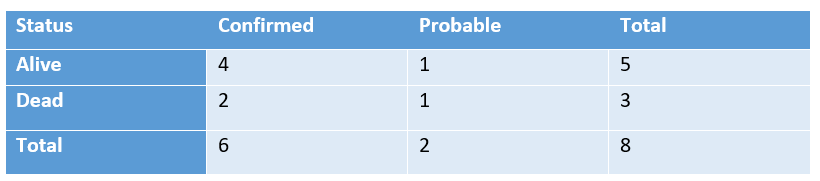
Since the previous Disease Outbreak News update published on 4 May 2026, three additional suspected cases have been laboratory-confirmed, and one new confirmed case has also been identified. As of 8 May 2026, a total of eight cases, including three deaths, have been reported, resulting in a case fatality ratio (CFR) of 38%. Among these, six cases have been laboratory-confirmed as hantavirus infections, all identified as Andes virus (ANDV).
Based on the currently available information, the overall risk to the global population remains low, while the risk to passengers and crew members aboard the vessel is considered moderate. The situation will continue to be closely monitored.
Case Distribution
Table 1. Distribution of reported Andes hantavirus cases by case status and outcome, as of 8 May 2026
Two medical evacuation flights departing from Cabo Verde transported two symptomatic laboratory-confirmed patients and one previously suspected case to the Netherlands on 6 and 7 May 2026.
As of 8 May 2026, four patients remain hospitalized. One patient is receiving intensive care treatment in Johannesburg, South Africa, while two patients are admitted separating hospitals in the Netherlands, and another patient is hospitalized in Zurich, Switzerland. The previously suspected case was subsequently transferred to Germany for further evaluation. Laboratory investigations, including both PCR and serological testing, returned negative results for Andes virus (ANDV). Consequently, the individual is no longer classified as a confirmed or suspected case.
Further investigations into the potential exposure of the first case and the source of the outbreak are ongoing in collaboration with authorities in Argentina and Chile. The outbreak is being managed through a coordinated international response, including in-depth epidemiological investigations, case isolation and clinical management, medical evacuations, laboratory testing and international contact tracing and monitoring.
The Swiss Federal Office of Public Health (FOPH) has confirmed that a passenger who travelled on the first leg of the voyage has tested positive for hantavirus and is currently being treated at the University Hospital Zurich.
Hantavirus infection has no specific cure, so treatment focuses on supportive care. Patients are usually hospitalised early for close monitoring.
Update #1 04/05/2026
Occurrence Update
On 2 May 2026, the World Health Organization received notification from the National International Health Regulations (2005) (IHR) Focal Point of the United Kingdom regarding a cluster of severe acute respiratory illness reported on a Dutch-flagged cruise ship. The cluster initially included two fatalities and one critically ill passenger. Laboratory testing conducted in South Africa on the same day confirmed hantavirus infection in the critically ill patient, who was admitted to an intensive care unit (ICU).
On 3 May 2026, an additional death was reported, while three more suspected cases remained onboard the vessel. By 4 May 2026, a total of seven cases had been identified, comprising two laboratory-confirmed cases and five suspected cases, including three deaths overall.
The cruise ship departed from Ushuaia on 1 April 2026 and navigated through the South Atlantic region, with scheduled stops at several remote and environmentally sensitive locations, including mainland Antarctica, South Georgia, Nightingale Island, Tristan da Cunha, Saint Helena, and Ascension Island. However, the extent of exposure or interaction between passengers and local wildlife during the voyage, or prior to embarkation in Ushuaia, remains unclear.
The vessel was carrying a total of 147 individuals, including 88 passengers and 59 crew members, representing 23 different nationalities. As of 4 May 2026, the ship was anchored off the coast of Cabo Verde.
What Is Hantavirus?
A hantavirus is a rare virus carried by rodents and transmitted to humans through contact with their urine, droppings, or saliva. A confirmed case on an Atlantic cruise ship has raised concern because such infections usually occur in rural settings, not on ships. The virus can cause serious illnesses like lung or kidney disease. Symptoms begin like the flu but can quickly become severe, making early detection and medical care very important.
There are different types of Hantavirus, but some can lead to a severe condition called hantavirus pulmonary syndrome (HPS), which affects the lungs and can become fatal if not treated early. As per a study in journal Immunology, Hantavirus pulmonary syndrome (HPS) is a rare, severe, and often fatal with up to 40% mortality, respiratory disease caused by Ortho hantaviruses, transmitted by rodents in the America.
It begins with flu-like symptoms (fever, aches) 7-39 days post-exposure, rapidly progressing to severe pulmonary edema and hypotension within 3-6 days. Treatment is primarily supportive in an ICU.
Transmission of Hantavirus
Unlike many viral infections, hantavirus does not usually spread easily between people. Instead, it is mainly linked to environmental exposure. Common ways it spreads include:
- Breathing in air contaminated with rodent waste particles
- Touching contaminated surfaces and then touching the face
- Direct contact with rodent urine, saliva or droppings
- Rarely, through rodent bites or scratches
Health experts emphasise that this is not a typical human-to-human spreading virus like flu or Covid-19, although rare exceptions have been reported.
Symptoms
One of the biggest challenges with hantavirus is that early symptoms can look like a common viral infection, making it harder to detect.
Early Symptoms of Hantavirus Infection
- Fever
- Muscle aches
- Fatigue
- Headache
Later, Severe Symptoms are:
- Shortness of breath
- Persistent cough
- Rapid breathing
- Fluid buildup in lungs
As the disease progresses, it can lead to respiratory failure, which is often the most dangerous phase. Symptoms can appear one to eight weeks after exposure, meaning people may not immediately connect the illness to its source.
Hantavirus infections can be severe, especially when they affect the lungs.
- Some strains have a mortality rate of up to 30-40%
- Severe cases can lead to acute respiratory distress
- There is no specific antiviral treatment, only supportive care
This means early detection and hospital care are critical for survival.
Prevention
While the risk to the general public remains low, simple precautions can reduce exposure:
- Avoid contact with rodents or their droppings
- Maintain proper hygiene and sanitation
- Use protective gear when cleaning potentially contaminated areas
- Ensure proper food storage to prevent rodent infestation
Treatment
Hantavirus infection has no specific cure, so treatment focuses on supportive care. Patients are usually hospitalised early for close monitoring. Oxygen therapy helps manage breathing difficulties, while severe cases may require ICU care or mechanical ventilation. Doctors carefully manage fluids to prevent lung congestion. Doctors may prescribe antivirals.
Treatment also includes managing fever, blood pressure, and complications. Early medical intervention is crucial, as the illness can worsen rapidly. Prompt hospital care significantly improves survival chances, especially when respiratory symptoms like breathlessness appear. For travellers, especially in remote or nature-heavy destinations, awareness is key.
The cruise ship outbreak is a reminder that even rare infections like hantavirus can pose serious risks under the right conditions. It spreads mainly through rodent exposure, not casual human contact. Its early symptoms may seem mild but can quickly turn severe.
As investigations continue, health authorities stress vigilance, not panic. For most people, the risk remains low but understanding how the virus spreads and recognising symptoms early can make all the difference.
x
x